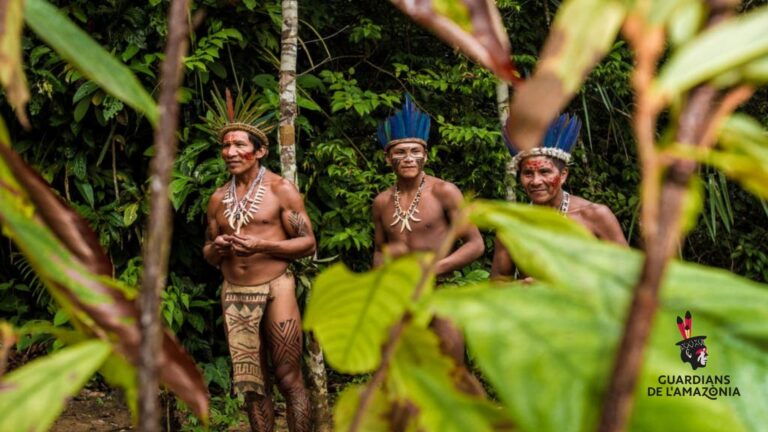
Currently, there are approximately 305 indigenous peoples in Brazil, totaling about 900,000 people, or 0.4% of the Brazilian population.
The government has recognized 690 territories for its indigenous population, covering about 13% of Brazil's land area. Almost all of this reserved land (98.5%) is located in the Amazon.
But even though roughly half of all Brazilian indigenous people live outside the Amazon, these tribes occupy only 1.5% of the total land set aside for indigenous peoples in the country.
The peoples inhabiting the southern Atlantic savannas and forests—such as the Guaraní and the Kaingang—and the dry interior of the northeast—such as the Pataxo Hã Hã Hãe and the Tupinambá—were among the first to come into contact with European settlers when they landed in Brazil in 1500.
Despite hundreds of years of contact with the expanding frontier society, in most cases they have fiercely preserved their language and customs in the face of widespread plundering and the ongoing invasion of their lands.
The largest tribe today is the Guaraní, with 51,000 members, but they have very little land left. Over the past 100 years, almost all of their land has been stolen from them and turned into vast, arid networks of cattle ranches, soybean fields, and sugarcane plantations. Many communities are crammed into overcrowded reservations, while others live under tarpaulins along the side of the roads.
The group with the largest territory is the 19,000 relatively isolated Yanomami, who occupy 9.4 million hectares in the northern Amazon—an area roughly the same size as the U.S. state of Indiana and slightly larger than Hungary.
The largest indigenous group in the Brazilian Amazon is the Tikuna, numbering 40,000.
Many Amazonian tribes have fewer than 1,000 members. The Akuntsu, for example, now number only four people, and the Awá only 450.
The Awá are the most endangered tribe in the world.
Not contacted
Uncontacted Indigenous Peoples in the western Brazilian Amazon.
Brazil is home to more isolated tribes than anywhere else on the planet. It is now believed that more than 100 of these groups live in the Amazon.
Some number several hundred and live in remote border areas in the state of Acre and in protected territories such as the Vale do Javari, on the border with Peru. Others are scattered remnants, survivors of tribes that were virtually wiped out by the impacts of the rubber boom and the expansion of agriculture over the past century. Many, such as the nomadic Kawahiva—numbering only a few dozen—are fleeing loggers and ranchers who are encroaching on their lands.
As pressure to exploit their lands increases, all uncontacted indigenous peoples are extremely vulnerable both to violent attacks (which are common) and to diseases that are widespread elsewhere—such as the flu and measles—to which they have no immunity.
Means of livelihood
Most communities rely entirely on the forests, savannas, and rivers for their livelihood through a combination of hunting, gathering, and fishing. They cultivate plants for food and medicine and use them to build houses and make everyday objects.
Basic crops such as cassava, sweet potatoes, corn, bananas, and pineapples are grown in the gardens. Animals such as peccaries, tapirs, and monkeys, as well as birds such as the curassow, are hunted for their meat.
Some tribes, such as the Matis, use long blowguns with poisoned darts to catch their prey. Most use bows and arrows, and some also use shotguns. Nuts, berries, and fruits such as açaí and peaches are regularly harvested, and people enjoy honey.
Fish, especially in the Amazon, is an important food source. Many indigenous people use fish poison, or timbó, to stun and catch fish. The Enawene Nawe, who do not eat red meat, are famous for the elaborate wooden weirs called “waitiwina” that they build along small rivers each year to catch and smoke large quantities of fish. Their Yãkwa ceremony is linked to these fishing weirs and has been recognized as part of Brazil’s national heritage.
A handful of peoples—the Awá, the Maku in the northwest, and a few isolated tribes—are nomadic hunter-gatherers. They live in small extended family groups and have few possessions, which allows them to move quickly through the forest. They can build shelters out of young trees and palm leaves in just a few hours.
Like all indigenous peoples, they have incredibly detailed mental maps of the land and its topography, flora and fauna, and the best hunting grounds. The Awá sometimes hunt at night using torches made from the resin of the maçaranduba tree.
Ethnobotanical Knowledge and the Role of Conservation
Indigenous peoples have unparalleled knowledge of their plants and animals, and they play a crucial role in the conservation of biodiversity.
According to scientific studies, indigenous lands are “currently the most important barrier to deforestation in the Amazon.”
In some states, such as Maranhão, the last remaining stretches of forest are found only on indigenous territories (the Awá are a good example of this), and these territories are under enormous pressure from outsiders.
Their role in conserving the rich biodiversity of the Cerrado (or savannas) and the Amazon rainforest is vital.
The Yanomami cultivate 500 plants for food, medicine, house construction, and other needs. They use nine different plant species solely as fish poison. The Tukano recognize 137 varieties of cassava.
Guarana, the cola-flavored soft drink found everywhere in Brazil, was known to the Satere Mawe Indians long before it was commercially available. They would spit out the seeds, grind them into a powder, mix it with water, and drink it before going out to hunt. The guarana ensured that they wouldn’t feel hungry and would have enough energy to keep hunting.
Many Brazilian indigenous peoples, such as those in Xingu Park, the Yanomami, and the Enawene Nawe, live in malocas—large communal houses—that house extended families, who hang their hammocks from the beams and share meals around the family hearths.
The Yanomami live in large communal houses.
Spiritual Worlds and Shamanism
Like all indigenous peoples in other parts of the world, Brazil’s indigenous peoples have very deep spiritual connections to their land. This is reflected in their rich oral history, cosmology, myths, and rituals.
Some communities use power plants or master plants, which allow them to enter altered states of consciousness in order to connect with spirits and heal illnesses.
Yanomami medicine men inhale yakoana or yopo, rapé, to summon their shamanic spirits, or xapiri. The xapiri play a crucial role in healing ceremonies and during the reahu, or funeral feast, when communities come together to consume the ashes of the dead.
The “pajé” of indigenous groups such as the Huni Kuin, Ashaninka, Puyanwa, Yawanawa, etc., drink ayahuasca—a brew made from the caapi vine—during healing sessions.
Some, such as the Awá, do not use stimulants or drugs, but enter a trance through the power of rhythmic dance and clapping to journey to the iwa—or abode of the spirits—where they meet the souls of their ancestors and the spirits of the forest, the karawara.
The transition from childhood to adulthood is often marked by ceremonies and seclusion. When a Tikuna girl gets her first period, she is painted black with genipap dye and adorned with eagle feathers. She sings, dances, and jumps over bonfires for up to four days with almost no sleep, and then isolates herself for several months, during which she is taught about the history of her people and informed of her future responsibilities.
The Xingu peoples are famous for their funeral ceremonies honoring deceased leaders, who are represented by decorated wooden logs called kwarup.
History
The history of Brazil's indigenous peoples has been marked by brutality, slavery, violence, disease, and genocide.
When the first European settlers arrived in 1500, what is now Brazil was inhabited by some 11 million indigenous people, who lived in about 2,000 villages or nations. In the first century of contact, 90% of them were wiped out, mainly by diseases brought by the colonists, such as the flu, measles, and smallpox. In the centuries that followed, thousands more died while enslaved on rubber and sugarcane plantations.
By the 1950s, the population had declined to such a low level that the eminent senator and anthropologist Darcy Ribeiro predicted that there would be none left by 1980. On average, it is estimated that one tribe became extinct each year over the past century.
In 1967, a federal prosecutor named Jader Figueiredo published a 7,000-page report documenting thousands of atrocities and crimes committed against indigenous peoples, ranging from murders to land seizures and slavery.
In a notorious case known as “The Massacre of the 11th Parallel,” a rubber baron ordered his men to throw dynamite cartridges into a village in Cinta Larga. Those who survived were killed when the rubber tappers entered the village on foot and attacked them with machetes.
The report made international headlines and led to the dissolution of the government's Indigenous Protection Service (SPI), which was replaced by FUNAI. FUNAI remains the government's department for indigenous affairs to this day.
Survival International was founded in 1969 in response to an article by Norman Lewis in the Sunday Times magazine about the genocide of Brazil's indigenous peoples.
The indigenous population began to grow gradually once again, although when the Amazon was opened up to development by the military in the 1960s, 1970s, and 1980s, a new wave of hydroelectric dams, cattle ranching, mining, and roads resulted in tens of thousands of indigenous people losing their lands and their lives. Dozens of tribes disappeared forever.
In 1985, twenty-two years of military dictatorship came to an end, and a new constitution was drafted. The indigenous people and their supporters exerted a great deal of pressure to secure more rights.
Much has been achieved, although Indigenous peoples still do not enjoy the collective land rights to which they are entitled under international law.
Threats and Challenges Today
Since Europeans arrived in Brazil more than 500 years ago, indigenous peoples have suffered large-scale genocide and the loss of most of their lands.
Today, as Brazil moves forward with aggressive plans to develop and industrialize the Amazon, even the most remote territories are now under threat. Several hydroelectric dam complexes are being built near isolated indigenous groups; they will also deprive thousands of other indigenous people of land, water, and livelihoods. The dam complexes will provide cheap energy to mining companies, which are poised to carry out large-scale mining on indigenous lands if Congress passes a bill being pushed by the mining lobby.
Two hundred representatives of the Mebegokre Kayapó Indigenous people met for five days to discuss the Belo Monte Dam and four other dams that will devastate their lands.
Kayapó dance at a protest against the dam, Piaraçu, Mato Grosso, Brazil, 2006. Two hundred representatives of the Mebegokre Kayapó indigenous people gathered for five days to discuss the Belo Monte Dam and four other dams that will devastate their lands.
In the south, many tribes, such as the Guaraní, live in appalling conditions in canvas shacks along the highway. Their leaders are systematically attacked and killed by private militias of armed men hired by cattle ranchers to prevent them from occupying their ancestral lands. Many Guaraní have taken their own lives out of despair over the lack of a meaningful future.
Resistance and Indigenous Organizations
Today, there are more than 200 indigenous organizations leading the fight to defend their hard-won rights. Hundreds of indigenous people took to the streets last year to protest the government’s plans to undermine their rights. Many have their own projects, health clinics, and bilingual schools. The Tikuna established a museum to showcase their technologies, art, culture, and language to white people.
Some tribes have produced videos and DVDs to document rituals and ceremonies for their descendants and to promote a better understanding of their way of life. The Roraima Indigenous Council carries out projects related to animal husbandry, fishing, and the preservation of seed banks for genetic diversity in order to ensure the tribe’s self-sufficiency.
Despite these achievements, endemic racism toward Indigenous peoples in Brazil persists. Under the law, they are still considered minors. The most important goal for tribal peoples in Brazil is control over their lands; Brazil is one of only two South American countries that does not recognize ownership of tribal lands.